Sunday, March 8, 2015

Riverwatch

During our Noyce research project in the Cache River area last summer, a fellow teacher, Jane Sechrest, and I started wondering about our local river, here in Harrisburg - the Saline River. As you drive through Southern Illinois, you notice that almost every stream or creek has a sign.  But there's not one for the Saline River.  We knew there was a river and that our county was named after it, but we weren't sure where it was.  That made us wonder if our students, or even the residents of Saline County, knew where it was.  Of course, we found it.  Our students can walk to it from the school.  So, we decided to become river watchers.   Last September, another fourth grade teacher, Lisa Ozment,  and I participated in a workshop called Stream Discovery  which was provided by The National Great Rivers Research and Education Center (www.ngrrec.org), located in Godfrey, IL - right on the Mississippi River.  This workshop trains teachers to lead students to monitor local streams and rivers and then report findings in a national database.

First, our classes took a field trip to the  river, where students observed and sketched the area.  They listed the many things they saw:  a great blue heron wading in the water, an eagle flying over; trees, shrubs and other vegetation; as well as tires and junk in the river.  Then, we had experts from SIU, our local university, speak to our classes about the importance of rivers.  They talked about how people use rivers, ways water gets polluted, invasive species, and the importance of clean water.  Of course the kids thought they were awesome! Special speakers are just, you know - special!

 The students decided we should find out if the Saline River was polluted.  So, the next week we decided to do chemical tests and see just what was in our water.  We did our fall chemical survey. I taught the students about all the chemicals that could be in water and what they would mean.  Basically, they just learned the names of compounds (phosphate, coliform, nitrate...) and whether or not it was desirable for them to be in the water. The next day, I made a quick trip to the river at lunch and got some water samples. We used a low cost water monitoring kit made by LaMotte (www.lamotte.com) to test for pH, turbidity, and several chemicals.  The kids loved this because it was like magic - the water changes color!  They put water and different tablets in test tubes, shook them for a period of time, and compared the color to a chart to determine the level/ presence of the chemical.  We found out that the quality of water in the Saline River was pretty good! We're going to do the winter chemical survey next week (while it's technically still winter) and compare our results.

There is so much to the Saline River project that it will take a few posts for me to describe it all.  So,  I'll tell you about the physical and biological surveys of the river that we did, and hopefully post a video.  Then I'll talk about possible projects for the future - from a "man-on-the-street" survey to find out just who knows where the Saline River is - to getting a sign - to maybe organizing a clean up day.  This is a cool project, but the most important part is how engaged my students were and still are.  Some of them feel sorry for our poor river that doesn't even have a sign - and want to do something about it! They can't wait to do the next surveys.  They are interested in their environment and they feel like they are scientists doing important work.  Which is true: they are.


Wednesday, February 18, 2015

Bird Basics

I'll start today with a personal note:  In the last month, I became a grandma!  After having been married and childless for 6 and 8 years, both my daughters decided to start a family.  At the same time! They have always liked to do things together! My youngest daughter gave birth to our first grandson, Isaac, on January 13. Three weeks and a day later, her older sister became a first-time mom to Matthew.  So, for the last month, I've spent more time at my daughter's homes, holding precious grandsons, than I have in my classroom. 

So, now I'm back home, all caught up with the grading and planning and ready to get back to teaching... and there is no school!  Snow Day! I'll take this chance to do a little catching up! 

Birds are everywhere, especially the backyard!  We, and our students, are so used to seeing them that we don't even notice them most of the time.  But, since they are right outside our windows, teachers have an opportunity to open students'  eyes and use birds to teach many science concepts.  Habitats, adaptations, migration, and camouflage are just a few.  I am also a big believer that people will value what they know and experience, so studying birds can lead to students who love
birds and are interested in conservation and motivated to care for their environment.  

Last summer, I attended a great (Inexpensive! I think it was $20) workshop called "Flying Wild" that is a program of the Council for Environmental Education (councilforee.org).  I used many activities from the resource guide that my students loved, from "Fill the Bill,"  in which students use different implements (tweezers, tongs, a straw...) to decide which bird's beak each represents, to "The Great Migration Game,"which is like a "choose your own adventure" life-sized board game. There is information for planning a Bird Festival and lots of online resources for birding and bird education.  If Flying Wild comes to your area, it is well worth your time to attend!

If you live in Illinois, the Illinois Department of Natural Resources (dnr.illinois.gov) has many great free teaching resources for use by Illinois teachers:  posters, workbooks, CDs, and trading cards of birds, animals, rocks and minerals, and many other topics.  They also have trunks full of items that teachers can borrow.  The bird trunk is full of bird field guides, skull models, books, CDs, and a bird DVD.  It even has stuffed birds that make their sounds when you squeeze them.  I used these items during our bird unit.  Needless to say, the students loved them.

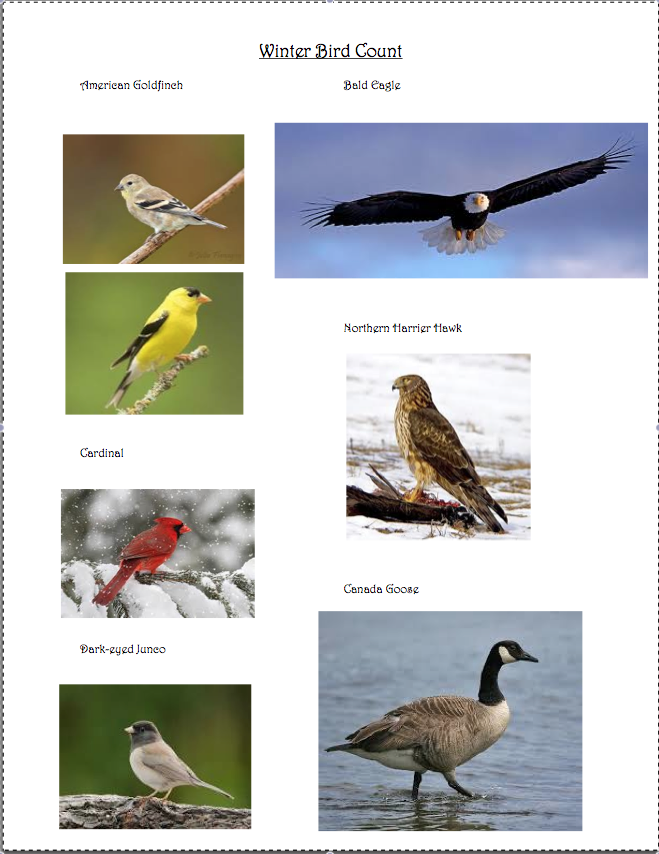
I finished off our bird unit by giving my students a winter bird checklist, with pictures of birds that spend the winter in Southern Illinois.  I'll try to include that so you can see it.  Students were to choose one day to look for the 6 winter birds and tally all that they saw.  Then they were to report their findings on ebird.org, which is one of several national databases that keep track of birds in the U.S.  I tell them that they are citizen scientists and this is important work they're doing. I also give extra credit!  My next project will be a bird feeding area on the playground.  I'm not sure if I'll get to that this year or next, though!

I'm all for using available materials to get kids excited about science and birds are certainly that - available!  


Weather Center

An easy "backyard" science project is to set up a simple weather center on the playground.  I made mine in a few hours from scrap wood I found in the garage.  On it is an anemometer, thermometer, rain gauge, and wind sock.  I also have a homemade barometer in my classroom.  Each day, my student weather reporter checks the temperature, wind speed and direction, precipitation, barometer, and type of clouds.  (And, sometimes gets locked out and has to knock on the window to be let back inside! Love  fourth graders!) They then give a weather report and record their data on a spreadsheet on the computer.  Keeping a spreadsheet allows us to make graphs and compare information from week to week, month to month, or even season to season.

As a result of paying attention to, and checking and recording the weather each day, my students are not only learning the names and purposes of weather instruments and types of clouds, but also developing some basic knowledge of weather forecasting.  I'm attaching a picture of my weather station.  You can see that it's not really a big deal, but a simple tool that can result in big learning (in the backyard!). 

Tuesday, December 30, 2014

What is Backyard Science?

Canoeing on Little Grassy Lake in beautiful Southern Illinois
Backyard Science...What does that even mean?  For me, it means just about anything you do to involve students in science outside the four walls of the classroom.  (Or, in my case three walls -  my room is triangular!) At any given time on any given school day, there are any number of students looking out the window, wishing they were "out there" instead of "in here."  So, I say don't fight it.  Use it!  We should let them go "out there" from time to time! Educators can take advantage of and capitalize on that natural curiosity, that yearning to get out the door and commune with nature!  

For years, it has been my goal to involve my students in their own learning, to get them to actually buy into this thing called education.  Science has been my vehicle for that.  So many of my kids come to my class saying that they hate science.  It is my goal to change that!  I love  a challenge! So, I have  searched for and dreamed up hands-on projects or outdoor projects for my students to be involved in. In this blog I plan to share my projects and other practical ideas for doing backyard science with elementary age kids. 

Keep in mind my loose definition of backyard science!  If you can do it outside or if you can "bring the outdoors inside," it is fair game for this blog!  I'll share ideas for things that you can do on your school's playground, in your neighborhood, at your community park, or in and around your area's lakes and rivers. There will be projects that can be done in an hour, a week, a few weeks, or even year-long endeavors.  I hope you will give one, or some, or even all of them a try!  

Thanks for reading!

Next Post:  Do-It-Yourself-Outdoor-Weather-Center